Showing posts with label Travelogue. Show all posts

Tuesday, November 4, 2014

The serene lake and the mystic mountain

Journey of lifetime to the abode of lord Shiva


Kailash, abode of mahadev the god of gods. It felt like a dream come  true when I got the intimation from ministry of external affairs that I was selected among the luckiest few for the Kailash Manasarovar yatra.The intimation came on May 2014 and I would be one among  the 18th batch (the last batch of the year) of the yatris for Kailash Manasarovar yatra on 15 Aug 2014. All the instructions and the requirements of the yatra were  clearly mentioned in the website of ministry of external affairs and the advices of former yatris from VSSC, Shri. Raghunatha Pillai (gsLVM3) and Shri. Vikram (SOG) helped me a lot in  prepararing  for the yatra. In addition to getting a long leave for a month sanctioned and the clearance formalities of foreign travel, I  had to carefully pick the items needed for the yatra  and  prepare  my mind and body  for the journey.

As instructed, I reported at Delhi on 15th August 2014 at Gujarathi Samaj Sadan where accommodation and sumptuous Gujarati food  were arranged for all the yatris for 4 days. The Kailash Tirth Yatra Vikassamithi at Delhi arranges all the facilities for the yatris and the satsang organized by them helps  to create a team spirit among the members. The next day was dedicated for detailed medical tests at the Delhi Heart and Lungs Institute and I underwent a series of  medical checks. The results were reviewed by the medical team of Indo Tibetan Border Police on the following day. I was relieved when my name was announced among the 40 members declared fit for the yatra. We stayed in Delhi for one more day for a  briefing on  the yatra at Ministry of external affairs and for completing the visa formalities. The payment was made to Kumaon Mandal Vikas Nigam Limited (KMVN) who arranges the food and accommodation for yatris on Indian side and also acquired the necessary US dollars and Chinese Yuvan required for the journey in Tibet region. On 19th Aug early morning, after receiving a warm sent off from the Delhi Nivasis with prayers, we set off for the Kailash Manasarovar Parikrama.

The kailash yatris are treated with reverence wherever they  go.   From the beginning of the journey itself warm receptions were given by various organisations. At Kathagodam we had our lunch and  switched our Volvo bus for a 27 seater bus to Almora where halt for the night was arranged at KMVN guest house. The bus ride continued the next day and we visited a few temples on the way through Almora. By evening we reached Dharchula, an ancient city on the banks of Kali river sharing the border with Nepal. The arrangement of the ponies and porters were made at Dharchula. Due to shortage of ponies I got only a porter to assist me, Mr. Devendra Singh Ghuniyal. Mr Devendra Singh is a first year BA student who provides his services to the Kailash yatris to earn money for his studies.

Next day we were taken to Pangla, a village 40 km from Dharchula in Jeep as the traditional route from Narayan Ashram was closed due to landslides. All the mobile communication with the outside world ends at  Dharchula as no networks are  available beyond . From Pangla our trekking commenced. The baggages were transported by ponies and I carried only an overnight bag with provisions for a night halt at the next destination. The destination for the day was  Sirkha, 7 kms from Pangla. The route is steady climb up through the mesmerizing Himalayalan Mountains filled with greenery and exotic flowers. By lunch time we reached Sirkha. After lunch the liason officer of our batch, Mr. Prem Singh a veteran in mountaineering who conquered the mount Everest 2 times and now working as DIG, ITBP, Chandigarh assessed the fitness of the yatris and was happy at everybody’s performance.

Next day, early morning at 5 O’clock, the trek commenced after consuming tea and biscuits. The destination was Gala a remote village in Indo Nepal Border 14 kms away from Sirkha. Though it was drizzling when the trek commenced, the sky became clear as we progressed the journey. By lunch time we reached Gala and rested for the day at the camp there. Destination for the following day was Budhi, 18 kms from Gala. One has to climb down 4444 steps near the banks of a roaring kali river in this route and there are many water falls that will drench you in this route. The Malpa village where a land slide took the lives of all the Kailash yatris including Protima Bedi (a famous Odissi dancer) and the porters in 1988 is in this route. I came to know from my porter that his father Devendra Singh  was also among them. Fourth day trek started from Budhi as usual at 5 O’clock. After a 3 km steep climb we reached the plains of Chilalekh a wonderful valley full of flowers. Further 7kms trek took us to the sinking village of Garbiang famous for hot samosas. From Garbiang, Border Road Organisation(BRO) has constructed a fairly motorable road for defense purposes and ITBP was kind enough to spare us their truck to cover the 7 km stretch to Gunji.

 At Gunji we reached an altitude of 12000 feet from mean sea level. The climate was very chilly and I had to wear 3 layers of warm clothes to protect myself from the chill . Medical tests are conducted to find out if any of the yatris are vulnerable to acute mountain sickness (AMS) and hence there is an extended day’s camping at Gunji. At Gunji, one gets a mesmerizing sight of the peaks of Annapoorna Mountain range in Nepal . We participated in the Bhajan at the ITBP camp temple there and also took part  in planting deodars as part of reforestation programme in the region. The Chinese border is just 22kms away and the last village Kuti on Indian side is 5 kms away from Gunji. Luckily all the members of our group were declared fit for the further yatra. On third day (From Gunji), we started in the morning to Nabhidhang which is 14 kms far from Gunji. We were dropped by the BRO trucks at Kalapani which is the source of Kali river where an ancient temple of goddess Kali is also situated. 

After breakfast at Kalapani camp the trek started towards Nabhidhang. The lush green forests and deodar trees gave way to barren terrain with a few cactus plants.. We could see the mighty Mount Sheshnag from there . By afternoon we reached Nabhidhang camp at the foot of the Nabhidhang mountain which is revered as a shakthipeet of Devi Parvathi (The mountain resembles the nabhi (naval) of goddess Parvathi).  From Nabhidhang the Om parvat is visible. Though the sky is always cloudy in these parts we were lucky to see  Om parvat and Mt. Seshnag. Nabhidhang situated at 15000 feet altitude is the last Indian army base near to Chinese border which is only 8 kms away from there . The base operates only 4 months in a year due to harsh environment. We were to reach the border next day by 05.30 hrs IST to match the Chinese timing of 08.00 hrs in the morning. The supper was served early by 6 pm itself and after a short nap we woke  up by 1’O clock to get ready for the trek. The trek started by 2 am in the morning with the help of torch lights. The night was very chilly and the cold wind penetrated even four layers of thick sweaters and jacket. Though the climb was difficult in the rarified atmosphere we reached the Lipu la (Lipulekh pass at 18000 feet altitude– Indi Chinese border) by 05.00 hrs IST.  At Nabhidhang itself we had deposited our memory cards and mobile phones containing the pictures taken at Indian side as a matter  of National security as advised the ITBP officials and loaded the cameras with fresh memory cards.                   

By 08.30 hrs Chinese time the Chinese convoy reached and the yatris from the 16th batch of yatris were seen coming back up the path. The Chinese foreign ministry official and soldiers arrived at the spot and exchanged greetings and we started the climb down the pass. A 5 km trek through steep downhill was  required to reach the motorable road at the Chinese side where buses were  awaiting to take us to the nearest town, an old trade hub, Taklakot (12000 feet altitude) 11 kms away. Our passports were verified at Lipulekh and were briefed about the Kailash Manasarvar Parikrama programme in Chinese territory. All yatris were  told to stick to the scheduled programme and visit to any other place other than those included in the programme were  prohibited. They also informed that photography in Taklakot city and Chinese military establishments are prohibited and if someone was found violating this they will have to face the consequences.

At Taklakot we were taken to the Chinese emigration office for customs checks and passport verification. We had one more day stay at Taklakot to complete the visa formalities and for acclimatization. Taklakot is a fast growing small city. Everywhere construction  was  progressing. The roads are all well paved and all the nooks and corners are  fitted with surveillance cameras. We spent the 2 days at Talkalot  roaming around the city and doing some shopping. Most of the vendors are Chinese at Talkalot, however a lot of Nepalis are working here and a market selling Nepali goods is also there. The next day we set for the Kailash parikarman after morning prayers. Two buses were arranged by the Chinese authorities for the yatra and we were taken to another small city called Darchen at the Southern side of Kailash. The road to Darchen passes through the small stretch between RakshasTaal and Manasarovar Lakes. We stopped at the permitted view points at both the Lake sides to enjoy the view.

We checked into the hotel at Darchen and went for a stroll after lunch. Since it is year of Kumbh a lot of Budhist and Jain believers had  come for the parikrama and to avoid the crowd and due to landslide the route to Ashtapaad (Southern view point of Kailash 5 kms from Darchen) was closed.  (Mt. Kailash is holy place for Budhist and Jains and is also called as Kang Rimpoche). Next day after breakfast the buses dropped us at Yamadwar from where the Parikrama (circumbulation) of Kailash starts. At Yamadwar there is a gompa and the view of southern facet of kailash is also visible from there. The selection of the porters and ponies were at Yamadwar. Smt. Peyma and Smt. Serene (hope that’s her correct name, anyways she was answering to my calling her Serene ;)) was selected as my Porter and pony handler.

The 9 km trek from Yamadwar leads to Deraphuk camp from where the north face of Mt. Kailash is visible. The trek path is through barren plane land between many hills on left side and Kailash on the right side. Many streams originating from Kailash is flowing near to the trek path. (Mt. Kailash is the source of many holi rivers like Sindhu, Bhrahmaputra, Sutlej and Karnali a tributary to Ganga)  At Deraphuk we can go as close as 2 km to the mountain and the spot is called Charansparsh. After lunch we spent rest of the day enjoying the scenic beauty of northern facet of Kailash and though we were hit by a small hail storm we could reach the Charansparsh and perform prayers. Mt.Kailash, pleased by our prayers provided us with its shining scenic views.
             
Next day’s trek started at early morning as we had  to cover nearly 19 kms and had to cross Dolma la enroute (Dolma pass – 18000 feet altitude).  The climb was at slow pace as  breathing was difficult and as we reached the highest point snow fall started with a freezing wind. Prayers and offerings were made to  Dolma (goddess Parvathi) and without wasting time we started to climb down the steep pass. At the foot of the steep is Parvathikund, a small pond (though small in comparison to other water bodies, it is as big as a football ground) which is believed to be the bathing place of Parvathi at Kailash. The water in Parvathi kund is considered holy and many pilgrims collect a sample of the water from the pond. Due to adverse weather conditions many porters were not willing to go down and collect water, luckily my pony handler Serene went down and brought the holy water for me.

The hail storm was terrific and walking became more and more difficult. A local Tibetan’s camp shed was on the path and we rushed inside. Luckily they were serving hot tea, soup and other Chinese foods. The hot Chinese green tea proved to be a good medicine against the freezing cold and all felt better after consuming  few bowls of noodles. When the intensity of hail storm reduced we resumed walking.  As we moved along, the snow fall stopped and the sky became clear. The camp for the night halt was at Zunzhuipu.

An unfortunate incident happened at Dolma pass. One of the yatri Smt. Annapoorna Devangan was affected by AMS while crossing the Dolma-la. The porters had carried her to Zunzhuipu camp. Since there was no improvement in her health condition, it was decided to evacute her to Delhi at the earliest. She was sent to Lipu-la in a land rover, ITBP soldiers carried her in stretcher to cross the pass. Due to bad weather helicopter could not be made available at the pass. ITBP soldiers again proved their efficiency. They carried her in the stretcher up to Gunji and from there  air lifted her to Pithoragargh where she was admitted to  a hospital. Later she was taken to her home  in Bilaspur, Chatishgarh and as per the latest news her health is improving though she is still in ICU.

After the stay at Zunzhuipu, the next day early morning we started our journey back to Darchen. The sky was cloudy and it was drizzling; however we resumed our trek through the slippery track. After 7 kms we reached the motorable road and waited there for the buses to pick us. We went back to Darchen in bus (5 kms), had light breakfast in the hotel and proceeded for Manasarovar parikrama as per the programme.  After 90 kms travel in bus we reached Qugu camp in the shores of Manasarovar lake. The camp at Qugu was a wonderful place with windows opening towards the serene lake. Themonastry of Qugu was   nearby. Two nights stay was  planned at Qugu camp.  After a hearty brunch everyone was busy washing the soiled clothes and drying it. In the afternoon we went for a stroll along the stretches of the Manasarovar and also had a dip in the holy lake. The atmosphere at Manasarovar lake was quite calm and energizing and many went into deep meditation at the shores of Manasarovar where the shining south face of Mt. Kailash was  visible as clouds permitted. Group prayers and havan were conducted at the Manasarovar lake during the two days stay at Qugu camp. On third day morning at Qugu camp the buses took us to hotel in Taklakot and we visited the memorial of Zorawar singh and Karchak monastery on the way. The Chinese authorities organized a farewell party at Taklakot and the party was delightful with many members from China and our group engaged in singing and dancing. Next day early morning at 5 am Chinese time (02.30 IST) we started our journey back to Lipu pass. The Director of Chinese external affairs and the Chinese army chief of the region came to see us off and then we bid adieu to the Chinese guides and porters.

Though the 5 km climb at Lipulekh pass was difficult we were happy to be back in the home land and was delighted to see the ITBP soldiers and porters waiting at the peak to welcome us. The return trek was tiresome as the camp at Nabhidhang was omitted. We had our breakfast at Nabhidhang and reached Gunji by evening. ITBP soldiers organized a farewell dinner for us. After the Bhajan with ITBP soldiers at the camp temple, we had dinner and the dinner party turned out in to a dance party soon. Next day early morning the trek resumed to Budhi. After night halt at Budhi the trek continued and we took a diversion from the path to Gala after climbing up the 4444 steps near Bindakoti and reached Garbadhar a small village where Jeeps to Dharchula  were awaiting  us . At Dharchula we said good bye to the dear porters who were of great help throughout the journey. Next day trip was to Almora by bus and a welcome back party was organized at the ITBP head quarters at Meerthiand. We also visited the Jageswar temple complex on the way. From Almora the journey resumed next day with warm receptions at Kathagodam by Uttarkhand Govt and reached Delhi by mid night on 9 September 2014. After the night stay at Gujarat Samaj Sadan, the next day we bid adieu to each other  and I started for Trivandrum.

The KailashManasarovaryatra is organized by Ministry of External Affairs, Govt. of India and the yatra is conducted as 18 batched during June – September. The yatra is approved by Indian Mountaneering Foundation as a high altitude trek and Central Govt employees are eligible for 30 days of special casual leave. Any Indian citizen below 70 years old holding a valid passport can apply for the yatra and the applications are invited by April through the website. The selection is based on luck draw and the medical test results at Delhi. The details about the yatra is given in the following link.


http://www.mea.gov.in/kmy.htm

Monday, January 2, 2012

MESMERISING MASINAGUDI


It was a pleasant morning in Ooty. The members of our family trip – comprising my parents, brother, uncles, aunts, cousins and grandmother tucked into a hearty breakfast. We then embarked on our sojourn to Masinagudi, a sleepy town nestled amidst lofty mountains, dense jungles and vast tea plantations. About two hours’ travel along the narrow, winding road saw our van rumbling into the Mahindra Zest Resort, where our accommodation had been arranged. A few metres from the destination, a long, silver- coloured snake slithering across the road into the thick bushes bordering the road welcomed us to Masinagudi. Subsequent to an elaborate lunch, we set out for a stroll inside the resort premises- clambering atop the tree house and enjoying the swings and hammocks fastened to large, sturdy trees. Soon, we were stepping gingerly into the clear, chilling waters of a gurgling stream flowing along the rear of the resort. As it was a spot frequented by wild animals coming toquench their thirst, we were cautioned against venturing into the opposite bank.

By evening, accompanied by a local guide, the younger members of our group, went on a trek to a nearby hill. The seasoned guide steered us along pathways with gentler slopes so that we could ascend without getting exhausted. As we approached the peak, the scenery became more and more glorious. The tall hills all around, shrouded in lush vegetation, with the silvery clouds floating beneath them, presented a magnificent sight. The steady breeze, coupled with the cool air, provided us with natural air conditioning. At the summit of the hill, there was a quaint temple, with Lord Muruka as the presiding deity. After we offered prayers, the priest, an elderly man with a matted beard, enchanted us with anecdotes of how the temple was often visited by leopards and how he sought asylum by bolting the sanctum sanctorum and crouching inside.

The wind was blowing with tremendous force, as if to sweep us off our feet. After the arduous climb, we relaxed, seating ourselves on boulders and taking snaps, drinking in the panoramic view. The calm prevailing in the pristine surroundings enervated us. After our descent from the hill, we halted for a cup of tea at a tea shop in Bokapura town.

The following day we awoke early and proceeded for a walk. There was a slight drizzle but that did not dampen our spirits. The imposing ghats were partially concealed by mist. Filled with apprehensions about being assaulted by wild beasts, but none quite voicing their fears openly, we strode ahead. Aside from dainty deer and monkeys hopping between trees, we caught sight of two giant squirrels with red, bushy tails scampering up a giant tree. Hiring two jeeps, we enjoyed a safari ride through the region, which constitutes parts of the Mudumalai Tiger Reserve. We spotted a few trained elephants (known as kumkis), deer and peacocks. Later in the day, the jungle safari facilitated by Tamil Nadu Forest department proved more fruitful. It was an exciting journey in a van through a rough path amidst the wild, undisturbed flora. We were fortunate to witness a majestic leopard prowling among the thick, tall grass. As the cameras clicked away, the young big cat gracefully vanished among the trees. We also sighted a herd of wild elephants filling their voluminous stomachs with large leaves, at a distance. Herds of spotted deer, lion- tailed macaques perched on trees and the charming peacocks put in an occasional appearance. Soon, a procession of wild bison crossed our path.

The elephant rehabilitation centre at Mudumalai was our next destination. Tourists from far and wide flock here in large numbers to behold the elephant feeding ceremony. One by one, the pachyderms were led out to their designated positions and fed with enormous balls of their diet- a mixture of ragi, salt, jaggery, rice etc. From 4-year-old baby elephants to 80-year-old seniors, the gentle giants of all ages gobbled up contentedly, the food proffered by their caretakers. During our return journey to the resort, we sighted elephants and wild bison among the woods lining the roads. A white rabbit hurried across the road, in front of our van. Since the inhabitants of the jungle roam freely after dusk, the roads in the region are closed to traffic from 8 pm to 6 am. Back in the resort, when I left the door of our room ajar for a short while, a monkey dropped in for a visit. As we hastily shooed it away, it swiftly grabbed sachets of milk powder from the table and sped away, much to our amusement.

We commenced our departure from mesmerizing Masinagudi the next morning. Our minds rich with memories of the beautiful mountains, the wildlife sanctuaries and their residents, we bid adieu to the captivating hill town.

Poetic Ponmudi

Even though I have visited Ponmudi earlier (of course it was some 15 years back), it didn’t occur to me that such a marvelous place lies within 1½hrs journey from Trivandrum. When my brother suggested Ponmudi trip for Onam, I wasn’t that excited. I was, like, oh what is there in Ponmudi. But the journey completely changed my mindset.

We started off at 1530 hrs from the city and reached Golden Peak, the KTDC resort just after 1700 hrs passing the 22 hairpins and several silver streams of ice cold water. After a tea at the resort canteen, we explored the picturesque scenery around the hill, where the resort was located. It was misty and chilly, but luckily rains eluded us at that time so we could enjoy a nice evening. At night a heavy downpour was there and that probably shattered our hopes of a campfire.

Next day morning by 0730 hrs we were ready to go uphill, but as the visiting time is strictly 0800 hrs to 1700 hrs, we went downhill and roamed a bit exploring rare spots and keeping our cameras busy. Then at 0800 hrs we could go uphill. The sight of the valley through the journey and from the hill top was breathtaking and not less magnificent than Munnar or Vagamon. The vast green land totally takes us to another world of serenity. That scenic beauty made the trip worth it. The view of the clouds moving over the hills, and the hide and seek of the sun was mesmerizing. One moment we had zero visibility because of the mist and couldn’t identify the person standing next to us, but the next moment it was all sunny and bright.

We had a buffet break fast at the cafeteria, and a very good traditional feast was arranged as lunch, complete with three ‘payasam’s. Contrary to the common belief the resort and surroundings are neatly maintained and is quite peaceful. There is even KSRTC Service right upto the resort.

After lunch we started our journey back. Even though we wished to visit Meenmutty, coz it included a bit of a trekking we decided to come again for a Meenmutty-Kallar exclusive visit. But all had this satisfaction of a well spent holiday.

______________________________________________________

പൊന്മുടി - (The Golden Peak) is a hillstation in the Thiruvananthapuram district of Kerala. Its located 61 km north-east of Trivandrum city at an altitude of 1100 m. It is a part of the Western Ghats mountain range that runs parallel to the Arabian Sea.

Ponmudi is connected to Trivandrum by a narrow winding road which offers a scenic view on the way to Ponmudi. The climate is always pleasant and it serves as a base for trekking and hiking. The tea-gardens here are also famous.

Other attractions near Ponmudi include Golden Valley and a number of rivulets and rapids, some even across the road. Located in a rich forest area, this whole place may be of interest to those who are interested in tropical vegetation. There is also a rich wildlife around these hills. Golden Valley is a sneak peek offered to the beauty of the hills. It is an access point to the river Kallar. Well-rounded pebbles, lush green trees, the cool water, fishes and the sheer wilderness of the park enthrall the visitor.

Another attraction in the region is Agasthyarkoodam which is one of the highest peaks in the Western Ghats and the highest peak (1868 m) in the district. This peak is famous for its wilderness, and can be accessed only with permission from the Forest Department. Meenmutty Falls is also a famous attraction in the range.


Wednesday, May 4, 2011

Mission Kashmir: A travelogue


To have a feel of winter in Kashmir is entirely a different experience especially for the ones who are seeing snow for the first ti me. We got an itinerary planned for 4 days stay at Srinagar. It was last week of February and as we stepped out of the flight, the freezing cold breeze gave a first hand feel of the spine chilling experience, which we were going to face during the sojourn. We had stock of enough winter clothes piled up in our baggage so as to counter the alien climatic conditions. The temperature outside was around 5 degree C .
On the first day we visited the Mughal gardens, Shalimar Bagh and Nishant Bagh. These gardens were built by the Mughal emperor Jahangir for his queen Nur Jahan in the year 1619. The Baghs are considered to be the epitome of Mughal horti culture. Shalimar Bagh has a terraced architecture and an axial canal which runs from the top to the lowest point.
The garden is linked to the Dal Lake through this canal. The best ti me to pay a visit to this garden is during the autumn or spring. It is during this time the garden is at its picturesque best due to the colour change in the leaves of the famed Chinar trees. On the way to the garden, our guide pointed to us the Char Chinar, which is an island in the Dal Lake. It is called so because of the four beauti ful chinar trees on the island. As it was winter, those trees didn’t bear any leaves.
Next day we moved on to visit Pahelgam, the ‘Valley of Shepherds’. It is about 95km towards west of Srinagar. Pahelgam is the entry point to the famous Holy Cave of Amernath. Enroute Pahelgam one can see Asia’s biggest Saffron fields. The roads leading to Pahelgam provide a very common sight of local shopkeepers selling pure Saffron (kesar) culti vated from their fields.
One of the shopkeepers there greeted us with Kesar-tea as a welcome drink. We purchased dry fruits and Saff ron from one of those shops. After having our bodies rejuvenated with kesar ka tea, we resumed our journey to reach the base of the mountain. The very first sight of snow all around us made us spell bound. As soon as we parked our car, the “gode waalas” came with the horses to take us atop. We had to bargain to fix the deal and started out on the horses after playing in the snow. We started our hike and it began snowing and it continued through out the climb. The horses took the much treaded muddy path on the snow clad mountains amidst the Pine and the Cedar trees. Snow fall which continued didn’t allow us to take snaps owing to poor visibility and the fear of snow wetting the lens. Two men who followed us with the horses stopped the ride in front of a valley for which I fall short of words to explain its breath taking views. Except for the presence of Santa and stars, the valley with its snow capped Pine trees made us feel like we reached some foreign nation to celebrate Christmas. Then we moved to the meadows of Baisaran. They call it the ‘Mini Switzerland’. It is a wonderful place to play with snow. We decided to descent after an hour of playing in the snow and making a snow-man, as our limbs started to become numb. Descending the hill felt more dangerous, as the path was covered with heavy snow and some places were slippery. To our big relief, the horses knew the way well enough to avoid such places. It took us about an hour to reach the base and we ran into the car and put on the heater.
Next day we proceeded to Gulmarg, which literally means the Meadow of Flowers. This hill resort is located in the Baramulla district of Jammu and Kashmir and it is about 55km southwest of the city of Srinagar. Originally called Gaurimarg by shepherds, this place was discovered by Sultan Yusuf Shah in the 16th century who was inspired by its grassy s l o p e s covered with wild flowers. But in winter it is hard to find any greenery once you r e a c h the top. Gulmarg is also famous for its premier ski resort of the country. We hired long boots and woolen jackets from Tanmarg which is the base of Gulmarg (Gulmarg is about 13km away from Tanmarg). As the road was wrapped with snow, we had to take metal chain for winding on the rear wheel to provide extra grip on the road. Our Scorpio took a single chain, but found it difficult to climb up the slippery road. We finally stopped the vehicle and walked for about a kilometer to reach the top. We took four sledges and decided to move to the place of Skiing. We had to bargain heavily to get the sledges for a fair deal and which I still feel was more! The snow clad peaks and the lovely landscapes have provided background for several Bollywood movies. We asked our guide to take us to the Govt. Ski shop. Though he refused initially, he succumbed to our pressure finally. The govt. shop offer Ski pads at the rate of Rs.300/- for the full day. We took one guy as a trainer as it is a bit difficult to put on the Ski shoes. Beginners route are available for the amateurs, which are less steep and safe. The ski area had a good crowd of Indian and foreign nationals. We did skiing for an hour and decided to start back as it was snowing heavily. We went back on the sledges and reached our car. On the way back to hotel we decided to taste the Kashmiri special non-veg dish, “the Waswaan “ which are meat balls made of mutt on. We went to Hotel Mughal Durbar and ordered the dish where we came to know that it is a general name and there are so many varieties available in Waswaan. We enjoyed the Rista- Waswaan with Kashmiri Pulav.
On day three, we moved our luggage to the house boat where we had planned to stay. House boats in the Dal Lake are stationary unlike the house boats in the back waters of Kerala. Small boat called “Shikara” is used as a main mode of transport and tourism in the Dal Lake. In the 17th century, the Mughal emperor Jahangir rightly said while living in a house boat in the mesmerizing Dal Lake, “If there is ever a heaven on earth, it is here!”.We proceeded for a Shikara ride aft er keeping the luggage in the boat. Vendors with variety stuff s row along with our Shikara to sell Kashmiri dry fruits, pearls, saff ron, jewelry etc. Moreover the view of Gulmarg, Sri Sankaracharya temple, Akbar Fort and other snow capped peaks from the Dal Lake is awesome. Aft er an hour’s ride in the Dal Lake we took a stroll in the Lal Chowk to do shopping. Shops in Lal Chowk display wide variety of Kashmiri items like carpets, woolen dress and dry fruits. Later in the evening we moved back to our house boat. Stay in Kashmir is incomplete without a house boat stay. Boats provide fi ve star accommodati on with beautiful, decorati ve interiors furnished extravagantly giving a plush feeling. And the most attractive feature of the house boat is its heater system which is basically a fire pot with wood burning inside. Pipes carry the smoke outside so as to avoid suffocation. A warm stay after two nights of the cold winter was a real welcome. Dinner was arranged in the house boat.
After a wonderful stay in the house boat, we kissed good bye to Kashmir valley with lots of beauti ful thoughts and memories.

Saturday, October 2, 2010

MY VISIT TO A DARGAH


It was a bright Sunday morning in Sriharikota & I found myself twisting and turning in my bed, shielding my eyes from the morning sun. It was only ten past eight, but my stomach was already growling . As I toddled off to the canteen, I found my friends excitedly talking about a Dargah nearby at place called Venad, about A. R. Rahman & his sojourns to this place.
It was my turn to get excited. My plan for the day was perspicuous in an instant. Visit to the Dargah became top priority. I learned from our seasoned SHAR drivers that Venad is a one hour drive from Sriharikota. We, a team of three set off to discover the place with a faith and anxiety never experienced before.
It was our maiden visit to a Dargah. Many people are unaware that a Dargah is the grave of a revered Sufi Saint. Sufism, the religion the saint preached & practiced is interesting. Sufism on contrary to Islam, emphasizes on mysticism wherein people believe that it is possible to achieve the highest state of enlightenment in this life itself.
This Dargah is frequented by A. R. Rahman once a year during the ‘Urs’ festival. The Dargah is patronized by the music maestro, who funds for the infrastructure as well as the festivals held there. Interestingly, these Dargah’s are considered the breeding grounds for music genres such as the ‘Qawwali’ & ‘Kafi’, widely believed to be the inspiration behind songs like ‘Khwaja mere Khwaja’ in the movie ‘Jodhaa Akbar’.
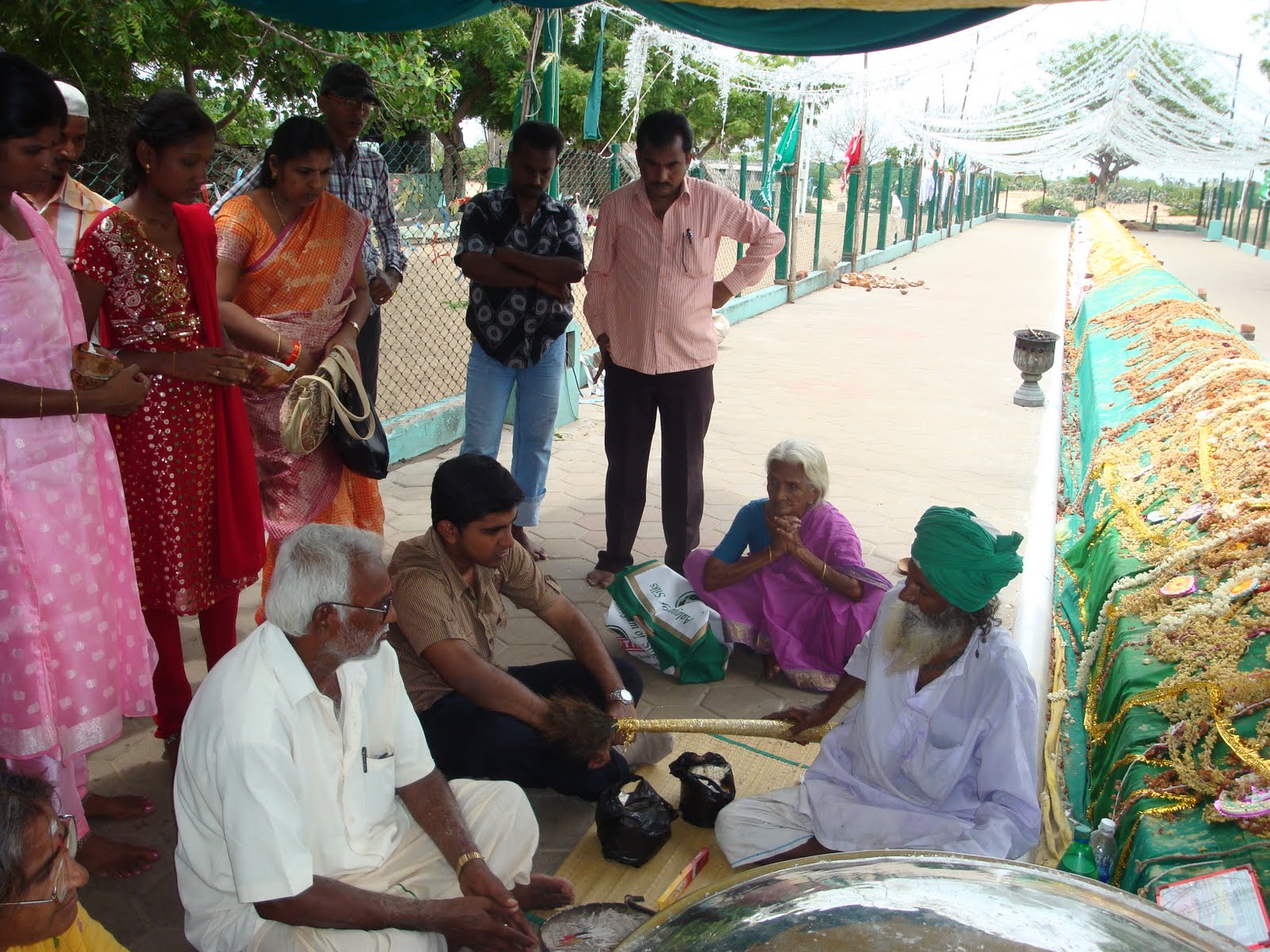
On reaching the Dargah, we were welcomed by a Sufi priest, a man with a green turban, an overflowing beard & a long golden stick adorned with peacock feathers. After the reception the priest soon set off to perform his regular rituals where in he blesses the devotees in return for local produce of grains & corn. As the devotees sat in for the prayer, we went around to have a look at a rather long Dargah. It was decorated with precious clothes in green and yellow with a tree at one end and a fence thereafter. A large array of padlocks across the fence caught our attention. Later, the priest explained that these padlocks are put up by devotees as protection against ‘jinnats’ and would be removed soon after they found solution for their adversities.
This Dargah has an interesting legend. It is said that the Sufi saint visited this place in 1414 A.D. with his sister, to preach Sufism across the shores of Andhra. The Sufi saint was lovingly called Baba by the villagers. The legend has that one day, the Baba told a group of children playing nearby to bury him in a pit that he had dug by himself. The children after doing so, were extremely worried and informed the elders. The elders immediately started digging for the Baba, only to find him moving deeper and deeper into the pit. As the elders dug up to the tree still situated in the Dargah, they heard a voice from above instructing them to leave the Baba alone. It is still believed that the Baba is alive and answers prayers of his devotees.
The Dargah seemed so calm and quiet, far from the din of the city that it brought an immediate tranquility to our mind. Even today the Dargah stands as an aide-mem’oire preaching oneness to all who visit here. It was noon by the time we bid adieu to this place.

Thursday, September 2, 2010

Journey to the valley of silence


It was a trip planned at very short notice (as always) when we decided to go to silent valley. Though the name “Silent Valley” was quite familiar to me, courtesy media hype regarding the proposed controversial hydro electric project, all my efforts to visit the place in the past went in vain due to some reason or the other. It took a call from my cousin, asking me about my plans for the weekend, to arouse my silent valley spirits again and I told him to be ready for a trip next day to the valley and even poked two of my uncles for the trip. We could arrange a reservation at the Forest Inspection Bungalow (IB) at Mukkali as we got relevant information from the internet.
After lunch from my home at Cochin, we four (my two uncles, cousin and I) set off to Silent Valley. Along the much improved NH43 (than when I traveled last) we reached Palakkad by 4 PM and after refreshments continued our journey through NH 213 to Mannarkkad. From Mannarkkad Junction we took the road towards right leading to Mukkali. We reached Mukkali at 6 PM, checked into our room reserved in the Mukkali Forest IB. It was quite
surprising to meet a large group from ISAC, Astro Physics Group with their family at IB who were taking rest after a visit to the core area of the forest for the day. All of us had a quite refreshing bath in the river Bhavani flowing near
the IB and had dinner from the local tea shop. The night at Mukkali IB was filled with music of the river flowing near the bungalow and occasional songs of birds and cicada!!
Next day morning we were ready to explore the core forest area of Silent Valley. Our ISAC friends had chosen a soft trek in the buffer area of the forest for the day. Since we couldn’t afford to miss the core area of renowned valley we preferred to hire a jeep and proceeded to the forest by 8.00 a.m. Our tour guide Nasser was quite talkative and kept pouring information about the valley and its history.The “Silent Valley” was referred so by the British,appropriate to the absence of cicada in the forest during early years when they explored the valley. The rain forest of the valley said to be dated back to 50 million years and is home for large number of endangered species including the Lion tailed Macaque and Nilgiri Tahr. The valley got the media attention when Pathrakadavu hydro electric project was sanctioned in the core area of the valley exploiting the water resources from Kunthi river. The project raised protests from the naturalists who finally succeeded forcing the government to set aside the project and declare the area as national park.
The 45 minutes long jeep journey from IB ended near the watch tower at the proposed dam site of the Pathrakadavu project. The watch tower offered a breath taking view of the Kunthi river also called the Sairandri. River at the proposed dam site is accessible by walk along a 2km long muddy path. An antique hanging bridge was in view at the dam site though entry to the bridge was prohibited. The river was muddy and a little wild since it was raining heavily for last 2 days.
After spending some time near river side wecame back to the watch tower. The museum operated by the forest department, provided essential information about the flora and fauna of valley and also about the geography of the
national park. By 2 p.m. we returned back to the IB with watchful eyes on the forest, eager to spot wild life. We were lucky enough to spot a troop of lion tailed macaques, monkeys, wild squirrels and birds.
With ever green memories and a handful of wonderful snaps in my camera, we bid adieu to the valley by 3pm after a late lunch from a local hotel with hope of revisiting the valley.
Rooms can be reserved at the Forest Inspection Bungalow of the Silent Valley by contacting the Wild life warden, Silent valley division in the address given below. A fax to the office of Wild life warden and a few phone calls for confirming the availability of the rooms to the Assistant wild life warden will be sufficient. Forest department also arranges a number of soft and hard core treks through the forests for those who are interested in walking through the forest.
The tribal colony of Attapady is nearby and those interested can have a visit to the colonies too. A number of private resorts also are functioning in the area for those who prefer it over the local shops and minimal stay at IB

Assistant Wildlife Warden,
Silent Valley National Park Range
Mukkali, Palakkad, Kerala, India
PIN: 678582
Tel: 04924 - 253225

Wildlife Warden,
Silent Valley Division
Mannarkkad, Palakkad, Kerala,
India
PIN: 678582
Tel: 04924 - 222056

Tuesday, August 3, 2010

Raidurg - The Unpublished Travelogue


Every trip to shar has been adventurous, starting from standing in queue from 4'o clock in the morning for booking tatkal, boarding the train with a waitinglist ticket which never got confirmed, traveling in general compartment, trips in state transport buses, catching late night trains, eating out in the unhygenic environment in dhabas, ..the list never ends. ...but nothing was never so adventurous than this particular trip of ours..and so memorable too...

The idea of the trip to Raidurg came when someone lamented about the tastlessness of food at SHAR. Our 'always ready to help' driver Muniraju suggested that he will bring food cooked at his house. That was an offer we couldn't resist. He mentioned about a fishing village on the border of SHAR's northern territory where we could get fresh fish. There was no second thoughts, the illtreatment metted out to our tastebuds by the canteen cooks was crossing all limits. We started our journey towards Raidurg in search of fresh fish which ultimately would satiate our desire for good food.

After traversing a few kilometers, we felt as if we were having a jungle saffari. The road had electric fensing on either

sides. Beside the fencing was thick forest. The forest, at times give way for beautiful lakes and backwaters. The road ahead of us looked as if it never ends and its not going to take us anywhere. There were no buildings in sight, for that matter there were not even a sign of human existence.
As milestones passed by, we even started doubting the intentions of our driver. As these ominous thoughts were engrossing our minds, the vehicle stopped in front of a giant stone gate. That was the entrance to an old temple. As we tried to enter the beautiful old dilapidated building, scores of bats came out. The sight resembled something like that of a ghost house. We roamed around the premises, appreciating the scale of stone work in the building and wondering why no one tried to preserve this, something like the church building in VSSC. Our driver asked us to speed up warning us of the difficulty in driving during late hours. We got into the car, partly heeding to his warning & mainly to meet our culinary requirements.

The pucca road gave way to kachha roads. After a few minutes of drive, we reached the last watchtower of CISF. Our driver stopped the car, we got down and walked a few steps to reach the river front. There in front of us unveiled the most beautiful place in SHAR.
The sight of "Raidurg" was so captivating that we forgot the whole purpose of our trip. In front of us was a vast river, and on the other end a beaitiful island. There was a boatman on the other side with his small boat which was the only way to reach that island. We communicated our intention to awail his services by using the only way of communication available there - 'whistling'. He responded in the positive and in a few minutes we were onboard the boat, propelled by the most fuel efficient method, by pulling a rope tied to a tree on the island.

As we ventured more into Raidurg's territories, our astonishment saw no bounds. We felt as if we were travelling back in time. There were no roads in the village, no motor vehicle, no schools, no hospitals, there were just walkways. On either side of the walkways were beautiful huts, walls of which were made of mud and the roofs thatched with palm leaves. The houses were too short that we wondered how people can stand inside them. The houses had beautiful fences made of tree barks, the likes of which is very difficult to find in our world.
The whole village was like a big family.As we walked across the village we could see eyes popping out of the huts, watching us as if we came from some other planet. Women were seen busy doing their household chores. Men were sitting in groups, engaged in some discussions. After a few steps we came across a small shop. There was nothing much for sale at the shop, except for a few packets of biscuits, two cigarette packets, bundles of beedis and half a dozen small snacks packets. A few men where sitting near the shop and were busy chitchatting. As they saw us, they enquired Who we are? Where we are from? Why we have come tere? and What they can do for us? Ofcourse all questions were posted in a polite manner.
Before we could say anything, our driver replied. "we are scientists from Kerala & we came there in search of toddy"of all the other reasons toddy. We stood there stumped at the answer which was never our primary intention. We thought we are screwed - comming to a village in groups and asking for liquor. Oh god!!! Who is going to save us from their fury?
Before we could react, one man from the group asked as to follow him. He took us to a small hut. In front of the hut was a lady who was sitting in front of a big pot. The man conversed to her in Telugu, the meaning of which we could not decipher. She took a mug and using a measuring glass, she took a mug full of toddy from the pot and offered to us. Oh! we just realised that we are in a village where toddy is a small scale industry & women work from home by selling toddy. We proceeded to take more mugs of toddy but was not impressed by the taste. The man who guided
us to the lady, understood our displeasure and told us that he will take us to a place where we will get better toddy.

After paying 5 rs per mug of toddy, we moved on to our next destination, wondering at the cheap rates at which toddy is offered and cursing all the liquor barons in civilised India for exploiting poor drunkards. At the next hut, the toddy was tastier. Number of mugs went up exponentially and before we could reach astronomical figures came the next warning from our driver in the form of a gentle reminder.

We winded up our trip and proceeded to go back. While waiting for the boat in the serene beach, we collected some beautiful shells from the shore. With hands full of exotic shells and mind full of sweet memories, we bid good bye to Raidurg.

We postponed our plan to buy fish as it was too late and went back to hostel canteen. The notorious dosa and sambar, the worst any cook can make, was waiting for us.

Wayanad


Starting our journey from Trivandrum on Thursday night, we reached in time at Kozhikode the next day morning , courtesy Malabar express. We checked in at a hotel near railway station and got freshed up. After having breakfast we left to the town bus stand to board a bus to Sultan Batheri, a major town in Wayanad district. The 2.5 hr drive from Kozhikode to Sulthan Batheri along the picturesque ghat road known as Thamarassery choram was breathtaking. As our bus wound its way up the Ghat, we craned our neck through the windows to have a peek at the nature’s wonder. We reached Batheri by noon and had our lunch at near by restaurant.
After lunch we hired 2 jeeps & set off to visit sultan fort ,the fort which Tipu sultan built during his regime. It is said that the sultan built this fort mainly to store his ammunition with an ambition to expand his empire to far south of kerala.After visiting the fort we left to the near by Kanthanpara Falls. The route to waterfall took us past sprawling tea plantations.
After having a lavish bath at the waterfall , we headed off to the nearby forest area were tribal people lived. Here one could notice their high raised dwellings built as precaution from the menace of wild life. They mainly earned living from farming and selling products which the forest offers them. It was late by that time and we had to leave for our ‘home stay’, where we had arranged a campfire and a sumptuous dinner.
Next day early in the morning we headed off to muthangya wild life park as it was the apt time to spot the wild life. Accompanied by a guide, we drove our jeep into the park with the excitement of encountering wild life in close quarters. First a heard of spotted deers caught our attention and in no time they disappeared in to the thick jungle sensing our presence. Finally we could spot a heard of wild elephants .Two among the heard were engaged in a war
while the others were busy grazing. It was amazing to watch them ,we quickly took some snaps and left the place. We continued our venture in to forest.
After 3 hours ,our adventurous tryst came to an end. We left the place with mixed feelings as we couldn’t site any beast in the wild . Soon we left to visit Tirunelli temple. It was a pleasant surprise to see a place of worship in middle of dense forest. From there we set off for the primordial Edakkal Caves ensconced atop the Ambukuthi hills near Ambalavayal.
The Edakkal Caves are basically two rock formations. They’re believed to have been formed by a large split in a huge rock. Legend has it that they were caused by the arrows fired by Luv and Kush, the sons of Rama. Like the world-renowned Ajanta and Ellora Caves in Maharashtra, the Edakkal Caves too were stumbled upon by British (in 1890) while on shikar. After getting versed with these historical facts we started our ascent to the pinnacle of the magnificent Edakkal caves. Soon we came across some engravings over the walls of the caves. It is said that these engravings shed light on the existence of a Stone Age civilization in Wayanad. After taking some snaps before those engravings we resumed our journey upwards .We were kissed by the mist and the sky was threatening to open up as we crawled on our 4 limbs during the last stretch of our trekking. Finally we reached the pinnacle even though it was pouring down.It was a breath taking view atop .But unfortunately we couldn’t spend much time as the guards asked
us to evacuate as it was getting darker.Then we got down and left for our home stay.
Next day we started early for the awe-inspiring Chembra Peak (towering 2,100 meters above sea level, Chembra happens to be the highest peak in Wayanad).The whole trekking exercise was a thrilling experience in itself .For people who love nature it’s a must visit. Though the trekking took a toll on us, we kept on marching as the picturesque chembra was so inspiring for us to move ahead. During the four hour long expedition along the peak, we came across several lakes with peculiar shapes, the one with a heart shape is worth mentioning.
Finally we drove back to sultan bathery. After bidding adieu to our driver chetans, we took a bus to Kozhikode for catching our train back to trivandrum.
Other places to see around in wayanad are pakshi patalam ,kuruva island,tolpatti forest. However, the monsoon season didn’t allow us to visit those places.
If Kerala is God’s Own Country, then Wayanad undoubtedly is its capital and hence a must visit for nature lovers around the world.

Wednesday, June 30, 2010

RAIDURG – THE LOST WORLD


How will you feel if you got a chance to step out of your daily life? Say, someone casts a spell upon you and you got transported to a different world – a different place, a different era. Where all identities of the present world are conspicuous by their absence so much so that you feel time itself has stopped moving. It would be a surreal experience. That’s how we (a bunch of 8 adventure-seekers) felt when we recently went to “Raidurg” – a place close to SHAR.

Now, SHAR is not exactly a ‘tourist’s paradise’. But, even in this forsaken place, there is a small pristine paradise. Situated on the northern fringe of SHAR, surrounded on all sides by the PULICAT and totally cut-off from the mainland is Raidurg. One of our friends who had visited this place recommended it to us as a place to get good fish. So we decided to give it a try and all 8 of us bundled ourselves into a hired taxi (the faithful ambassador) and landed at the place.

Raidurg is a small village and the only means to reach it is by a boat. We saw a fisherman on reaching there and we hitched a ride in his yacht.

As we entered the village, we felt as if we had gone back in time by at least 50 years. There were no roads, only man-made trails. The huts in the village were very short. One can enter only by crawling on all fours, and then inside, there isn’t any place to stand upright. Bushes and shrubs around the huts served as fences. As we entered the village, we could see people sitting in front of their courtyards and passing away their time in idle chit-chat. Children roamed about on the streets playing their merry games and women were busy in their homes doing their daily chores. It was like a ‘50s black-and-white movie playing.

We started wandering around. Wherever we went, people stopped whatever they were doing and stared at us. It was as if they couldn’t believe people from outside could come into their small hamlet.

We were roaming around when our de-facto guide (the taxi driver) took us to a house where a lady was busy preparing something – and the next minute, we all had a glass of toddy in our hands. It seems toddy making is a cottage industry here. We had a drink but didn’t like the taste. Sensing this, our guide took us to another house where the toddy tasted much better. So, while we entered the village looking for good fish, we ended up having toddy instead. Great !!!

The place drew us towards itself and we were happy to oblige. We wanted to spend as much time as possible, but couldn’t as evening was approaching fast and we had a long way to go back. Besides, we had to go to work the next day. So, spending the night there under the open skies was out of question though it would have been great. We felt sad to leave the place. But, on the bright side, we can always come back here. This place is not very far from SHAR centre and if one has any spare time, he can always plan a trip here. Atleast, it will make our wretched stay in SHAR feel better. It’s with such happy thoughts that we finally bid adieu to the place and came back to our hostel rooms.

TRIVIA:

  1. There is an old temple on the way to Raidurg. This temple is now in ruins. Anyone interested in historical adventures can check it out as it looks to be a great place for exploration.
  2. Don’t forget your swimming trunks while going to Raidurg, else, you may miss out on a great swim.
  3. This place has a wide variety of sea shells. Anyone with a keen eye can get a nice shell without much effort as we got this time.
  4. Though the village is not connected to the mainland, it still has some modern amenities like DTH, telephone, schools etc. yet it retains its old world charm inspite of that.
  5. On the way to Raidurg, there are lots of small lakes, each offering itself as a potential spot for picnic.


Tuesday, June 1, 2010

Vagamon


We were looking for some places in and around trivandrum to beat the heat. After extensive discussions between us, we settled down to Vagamon, “to explore the unexplored”. Thanks to internet, we could get lot of information about vagamon and Google Map provided us the necessary route with each and every twist and turns. Ten of us, consisting of people from all age group left trivandrum at 6am in two cars and headed towards Vagamon.
As it was Good Friday and Vagamon being a piligrim centre, we got stuck in the traffic in the hilly area and it took around 3 hours to clear.We reached the cottage by 3pm. Cool breeze of Vagamon compensated all the tiredness and we were at our youthful best again to explore. The Silver Cloud Castle Cottage was very new and had wonderful views of the vast expanse of vagamon. The rooms were beautifully maintained and had a spanking clean bathroom and toilet. Silver cloud incharge was kind enough to accept our request for providing food during our stay.
After the refreshments we set out in the evening towards the nearby flushing meadows. Before we could traverse the meadows, the gathering dark clouds cast their spell and made us to look to our watches in disbelief to know the time. The darkness kindled the “Fire Flies” hiding somewhere in the grass and they came as an army to light the area and we enjoyed the sight. Coming Back to the cottage, we drew the day to close with a campfire and sing-song!!
The evening outing to meadows was so tantalising that the team was eager to scale the small grass covered hills which made even the Kumbhakarnas woke up early at 5am. It was an unforgettable experience to find the silver white clouds down under our feet as the water droplets in the mist kissed our faces all over. Our hosts, Silver cloud Castle had arranged a delicious, sumptuous breakfast with hot puttu and kadala curry. With renewed vigour, we headed straight to the Pine Valley. The pine valley was perhaps the coolest place in vagamon at that time of the day. It offered a refreshing cool air that no AC could have offered.
A kilometer away from Pine valley is the Suicide Point. With no intention of ending our life prematurely, but just to have a glimpse of the bottomless chasm which is a rarity in the grasslands, we walked nearly a kilometer from the main road. It was a really breath taking view and the sight itself would kill a weak hearted person.
Coming back tired and exhausted to the cottage, our only solace was again the chef of the cottage who was ready with variety of food items for lunch. The next item on our itinerary was a visit to Rose garden and a Lake located in Vagamon Heights resorts. The paddle boating in the placid lake took us to the rose garden where the female members of the team were face-to-face with more than 250 varieties of roses. Though plucking the roses was not allowed, the sight of so many roses at one place was more than what we asked for. After this we headed towards Kurisumala, the hill dedicated to followers of christianity and visited by people from all religions.
After having a cup of tea at the bottom of hill, we came back to the cottage and relaxed for a while. Still energetic members of group went around in search of logs of wood for camp fire.All of us had a nice time in camp fire with dumb charads as main attraction of the night. Next day, after having breakfast in the cottage we left vagamon and took some beautiful pictures enroute to trivandrum.Finally we all would like to thank silver cloud castle cottage for their wonderful hospitality and making us to feel homely in the cottage. Still some more places were left unseen and really its worth to visit once again and enjoy the beauty of nature.

About Vagamon
Nestled in the laps of the Western Ghats is Vagamon which is an enticing hill station of Idduki-Kottayam border in Kerala and is still untouched by the milling crowds. Vagamon is situated at an elevation of 1100 metres above sea level and it is a very ideal tourist spot surrounded by the greenery of tea gardens, beautiful meadows, deep puzzling valleys and dales. The enchanting hill station dotted with tea gardens is promising enough to be one of Indias foremost eco-tourism projects and is destined to have a major say among the contemporary holiday resorts in the country. Grass covered hills, velvet lawns and the cool mountain air make Vagamon a perfect holiday retreat. The slopes of the Hills of Vagamon are not very steep and hence it facilitates adventurous sports like trekking, rock climbing, paragliding and other exciting activities.
Like all good things in life, Vagamon too has to be experienced, not just read about or its stories merely listened to. Pristine and blessed by nature,this place would make the tourists come back again and again, so that they could rejuvenate themselves and cherish memories of this enchantingly beautiful land.
The vista of mist-clad pinnacles of the bluebrown hills, the rocky terrain clad in lush green vegetation and the wild multi-colored blossoms that sway in the breeze will surely take away your breath. Inhale the fresh air coupled with the heady aroma of spices from the nearby plantations. While you ascend the stony serpentine paths leading towards the hills you will feel a slight shiver as the cool breeze caresses you and drifts away. Vagamon, encircled by a string of three hills Kurisumala, Murugan Hill and Thangal Hill dedicated to three separate religious faiths-Muslim, Christianity and Hinduism is a placid place with inexplicable beauty and offers all sort of activities from pilgrimage to nature trails and deluxe resorts. Vagamon awaits you with its untainted splendor.

Ashok & Kiran

Thursday, May 13, 2010

KAKKAYAM

We started out on a 2000 year model Mahindra Jeep from Chakkittapara after visiting one of our friend’s home at around 2.45pm. This is the vehicle best suited to kiss the roads over there. Don’t think of making your SUV climb up the road, as he may go on strike mid-way. Or if you are so particular then no comments.
En route to the dam site, the catchment area of Peruvannamoozhi irrigation project offers a feast to your eyes . If SLR is your close companion, then you will sure be gifted with a couple of mesmerizing snaps of nature romancing with meandering river down the mountain set against the beautiful sun. I was helpless then as I felt that my Sony DSC 10Mp 5X had a limit to which it can offer.
Now I ‘ll share something techy. The Kakkayam dam comes as part of the Kuttiyadi Hydro Electric Project & is located at a height of about 2450ft above MSL. It has a total installed capacity of 125MW. The penstock runs down from the dam site and goes through various tunnels and hills to the Kuttiyadi Tail race power house at Kakkayam. Water coming out of this power house joins a river and is utilized for Peruvannamoozhi Irrigation Project.
After a payment of Rs 10 per head at the base near the power house, it took us about 45 min to reach the dam site. When you climb up the winding road, you will not miss a giant old tree, ”Tholaranji” as it is called in Malayalam, standing proudly. It bears a name board which claims she is about 87years old. Her girth & majesty affirms it. Vehicle is permitted only upto the checkpost from where it is a 10 min walk to the dam site. It was written there that you are not allowed to carry cameras and that photography is strictly prohibited. But how could I, when nature is presenting its best before me? It is not just the dam but a gorgeous waterfall and a cliff that adds splendor to this place. This location is about 1.5km from the dam site. You feel the forest getting denser almost forming a canopy over you ,cutting off light by a certain amount as you walk to that spot. The sweet sound of water streams and beauty of forest keeps you calm. This spot is called “Urakkuzhi”, a perfect blend of beauty of the falls and majesty of the rocks. Unlike other falls, at Urakkuzhi viewpoint, a rope bridge stands over the rocks from where the water starts falling down. Literally you are hanging over a cliff. History has some stories claiming that the body of Rajan, REC student at the time of Emergency in the state was pushed down from here, after serious lock up injuries at Kakkayam Police camp. The forest guard had so many stories to tell about Rajan’s demise & he even showed the exact place where Rajan was thrown down. The spirit of Rajan must be making him tell his fate to all the visitors who comes there to enjoy nature’s gift.

I then enjoyed a bath in the nature’s bath tub nearby. No pool could ever give you the coolness and purity of water which this one offers. But I couldn’t swim there for long as it was getting darker and moreover this water body has small fishes and tadpoles and I had only a thin towels to cover me up!! We quenched our thirst from a pure stream of water running down the rocks which left us refreshed.The taste was so natural with a sweetness that reminded me of taking water after having a bunch of gooseberries.
The scheduled train at night and the dusk forced us to say good bye to Urakkuzhi then. The guard there didn’t forget to tell us that they had seen elephants having water from the spot where we had bath. It would have been a National geography channel snap, had some tuskers been there.

ROBIN